The Freedom Audit: What the Digital Nomad Life Actually Costs
The first months of digital nomad life feel like a reward you've been waiting for. Then, quietly, it starts costing more than the rent.
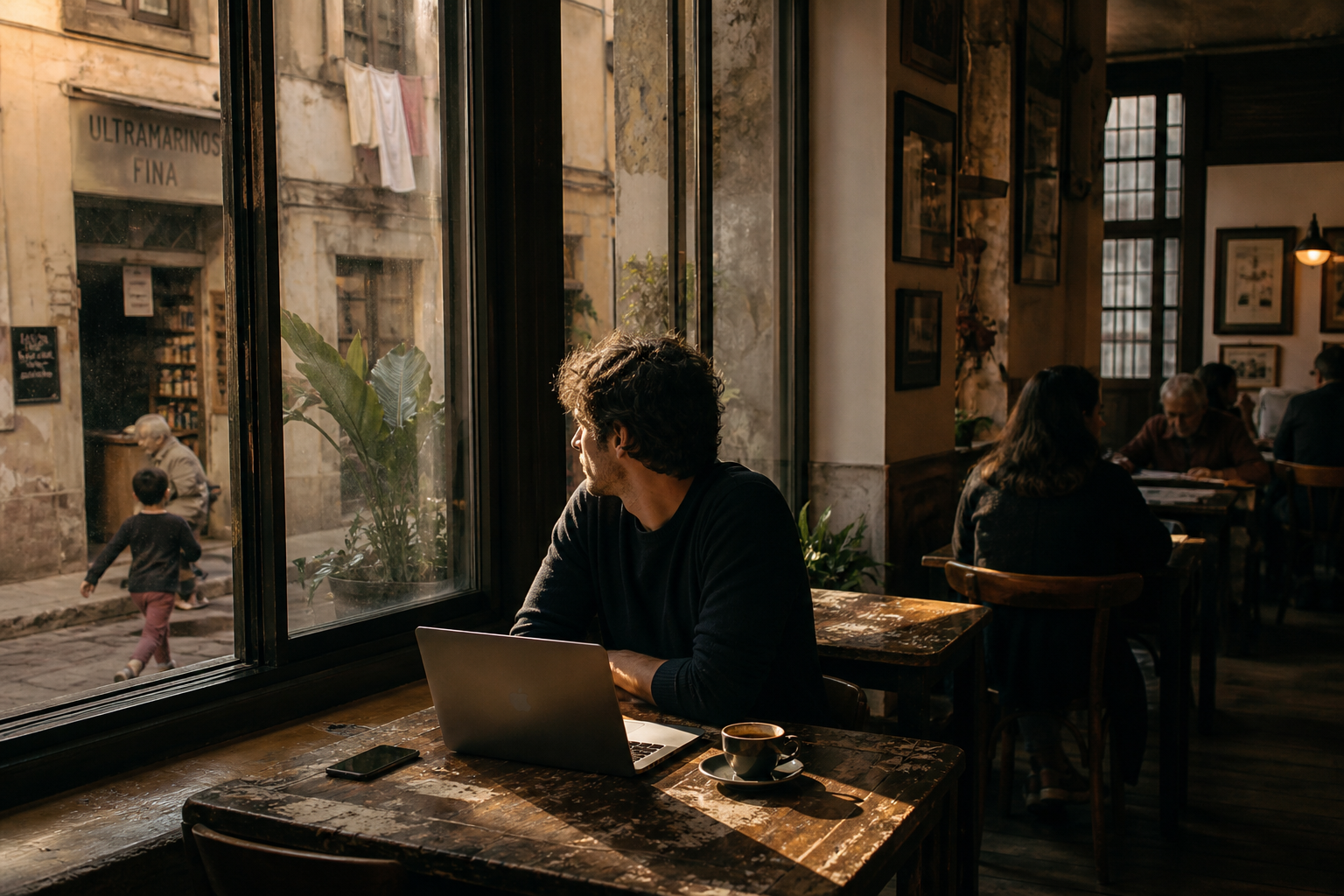
The first three months feel like a reward you've been waiting your whole career to collect. You find a café in Medellín — always a café, always the right light at the right hour — and you open your laptop and think: I built this. Nobody told me to come here. Nobody is making me stay.
That feeling is real. I want to be precise about that, because what comes later is easier to understand if you start with how genuinely good the beginning is.
The freedom is real. The light through the café window is real. The absence of a Tuesday morning commute, the particular small pleasure of working from a balcony in a city you chose — these things are not marketing. For the first six months, the experiment works.
"Then, without any single moment you can point to, it starts costing more than the rent."
According to a widely-cited study, 40% of digital nomads feel lonely often or always, and 77% have experienced burnout at some point. What the statistics don't capture is the texture of it — the specific way digital nomad burnout and loneliness arrive. They don't announce themselves. They arrive as a quiet subtraction.
You've been at the same coworking space in Lisbon for three weeks. You know the Wi-Fi password and the best chair and roughly when the good espresso machine is free. You have nodded at the same seven people forty times. You do not know any of their names. Not because anyone has been unfriendly, but because the entire architecture of the space is designed for people who are passing through — the check-ins are frictionless, the hot desks belong to whoever showed up today, the community Slack has 340 members and moves too fast to land in.
On your phone, somewhere in the third drawer of apps, there are three WhatsApp groups: Lisbon Nomads April, Chiang Mai Crew 🌴, and something called Tbilisi Life. The last message in all three was sent by someone else, months ago. The people in those chats are in other cities now, in other chats, with other people they also mean to stay in touch with. The connections were real. They just didn't have anywhere to root.
There's a question that starts to feel strange after a while.
Where are you from?
It comes up at dinner tables and coworking spaces and hostel common rooms, and for the first year you have an answer. After two years the answer starts to feel like a formality. You are from the place on your passport, technically. But you haven't lived there in eighteen months. You have strong opinions about which neighbourhood in Bangkok has the best street food and no opinions about what's happening in the city where you grew up, because you stopped following the local news somewhere over the Atlantic. The academic literature calls this a "liminal experience of identity transition." In practice it feels like answering a question nobody actually asked with information that no longer quite fits.
This is not a tragedy. Most nomads find a way to hold it — some with humour, some with the practiced ease of someone who has explained their life choices too many times. But it costs something. The nervous system adapts to multiple frameworks at once, which makes you flexible and keeps you slightly unmoored at the same time.
In Chiang Mai, a local software engineer earns considerably more working remotely for a European company than they would from a Thai employer — often several times the equivalent local salary — without leaving their apartment. The arithmetic runs cleanly for the individual. It runs less cleanly for the neighbourhood.
Rents in central Lisbon have climbed dramatically — by some measures more than doubling in the most affected neighbourhoods since 2020. In July 2025, hundreds of people took to the streets in Mexico City's Roma Norte and Condesa — signs reading Gringo: Stop stealing our home — after years of rising rents in neighbourhoods that had long housed working families at prices those families could no longer find.
The nomad who is paying the rent does not intend this. But wanting no harm and causing none are different things, and a piece that skips the gap between them is not being honest about the full cost of the exercise.
What many nomads eventually do — the ones who stay in the life rather than cycle out of it in exhaustion — is slow down.
Not stop. Slow down.
Stay for two months instead of two weeks. Join a gym instead of a day pass. Find a neighbourhood café where you know the name of the person behind the counter, learn one or two words of the language badly and apologetically, and develop the kind of relationship with a place that is not the same as living there but is meaningfully more than passing through.
This is the honest version of the life. Not the Instagram version, which is always arriving somewhere. Not the cautionary version, which is always counting the cost. The honest version is quieter than either: a person in a city they chose, knowing its rhythms well enough to have a bad day in it, which is the minimum entry requirement for a place to feel real.
"The freedom, it turns out, is not in the movement. It's in what you choose to do with the stillness you can occasionally afford."
This is what nobody tells you before you buy the one-way ticket: the freedom is the easy part. The hard part is figuring out what you actually want once you've had it.